| The PenPal Project | |
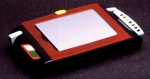 |
The PenPal - a portable communications device for children aged four to six -
was designed and prototyped at Stanford University in the context of the
1994 Apple Interface Design Competition. The PenPal enables children
to learn by creating images and sending them across the Internet to a real
audience of friends, classmates, and teachers. A built-in camera and microphone
allow children to take pictures and add sounds or voice annotations. The
pictures can be modified by plugging in different tools and sent through the
Internet using the PenPal Dock.
|
| Presentations and Publications | |
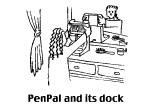 |
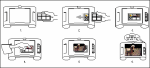
One of the first class assignments was to understand the target user group (in this case children aged four to six) and how the product could be used. Various scenarios were generated showing different tasks that could be performed with the PenPal device. |
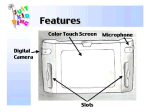 |
This final presentation summarizes the design steps the team went through during this project: (1) understanding the users, (2) developing usage scenarios, (3) prototyping key interaction elements and (4) conducting usability tests. It got the team selected to go present its work at Apple Computer. |
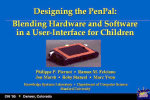 |
After the competition was over the PenPal project was presented at the Conference on Computer Human Interaction '95 in Denver (the corresponding conference paper is available below.) |
 |
Designing the PenPal: Blending Hardware and Software in a User-Interface for Children, in Proceedings of the Conference on Computer Human Interaction (CHI '95), 1995, pp. 511-518. |
| Prototype | |
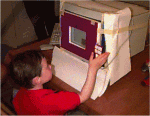 2MB Shockwave movie |
In order to understand the issues in merging physical and screen interfaces, a software prototype was developed and tested. To model the physical interactions, a touch-screen was taped onto a computer monitor and a large-scale cardboard mock-up of the PenPal was taped on top of the touch-screen. The cardboard mock-up included the main hardware features of the PenPal: two tool slots, and a coaching button at the top of the screen. The software was controlled through a combination of behind-the-scenes manipulation by a project member and of direct user interaction with the touch-screen. |